

1) Elliott Wave Theory
1.1 What is Elliott Wave Theory?
Elliott Wave Theory is named after Ralph Nelson Elliott (28 July 1871 – 15 January 1948). He was an American accountant and author. Inspired by the Dow Theory and by observations found throughout nature, Elliott concluded that the movement of the stock market could be predicted by observing and identifying a repetitive pattern of waves.
Elliott was able to analyze markets in greater depth, identifying the specific characteristics of wave patterns and making detailed market predictions based on the patterns. Elliott based part his work on the Dow Theory, which also defines price movement in terms of waves, but Elliott discovered the fractal nature of market action. Elliott first published his theory of the market patterns in the book titled The Wave Principle in 1938.
1.2 Basic Principle of the 1930’s Elliott Wave Theory
Simply put, movement in the direction of the trend is unfolding in 5 waves (called motive wave) while any correction against the trend is in three waves (called corrective wave). The movement in the direction of the trend is labelled as 1, 2, 3, 4, and 5. The three wave correction is labelled as a, b, and c. These patterns can be seen in long term as well as short term charts.
Ideally, smaller patterns can be identified within bigger patterns. In this sense, Elliott Waves are like a piece of broccoli, where the smaller piece, if broken off from the bigger piece, does, in fact, look like the big piece. This information (about smaller patterns fitting into bigger patterns), coupled with the Fibonacci relationships between the waves, offers the trader a level of anticipation and/or prediction when searching for and identifying trading opportunities with solid reward/risk ratios.
1.3 The Five Waves Pattern (Motive and Corrective)
In Elliott’s model, market prices alternate between an impulsive, or motive phase, and a corrective phase on all time scales of trend. Impulses are always subdivided into a set of 5 lower-degree waves, alternating again between motive and corrective character, so that waves 1, 3, and 5 are impulses, and waves 2 and 4 are smaller retraces of waves 1 and 3.
In Figure, wave 1, 3 and 5 are motive waves and they are subdivided into 5 smaller degree impulses labelled as ((i)), ((ii)), ((iii)), ((iv)), and ((v)). Wave 2 and 4 are corrective waves and they are subdivided into 3 smaller degree waves labelled as ((a)), ((b)), and ((c)). The 5 waves move in wave 1, 2, 3, 4, and 5 make up a larger degree motive wave (1)
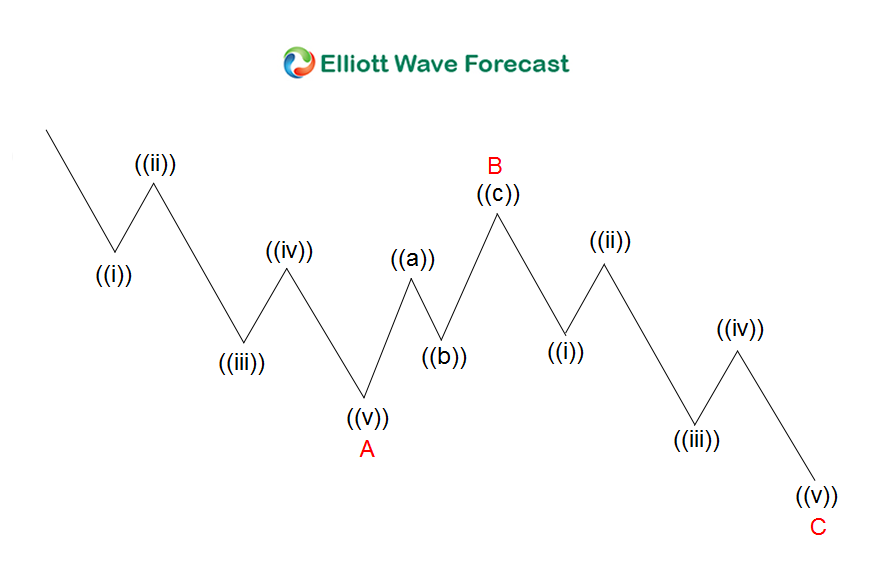
Corrective waves subdivide into 3 smaller-degree waves, denoted as ABC. Corrective waves start with a five-wave counter-trend impulse (wave A), a retrace (wave B), and another impulse (wave C). The 3 waves A, B, and C make up a larger degree corrective wave (2)
In a bear market the dominant trend is downward, so the pattern is reversed—five waves down and three up

2) Fibonacci
2.1 Fibonacci Retracement and Extension
Fibonacci Retracement in technical analysis and in Elliott Wave Theory refers to a market correction (counter trend) which is expected to end at the areas of support or resistance denoted by key Fibonacci levels. The market is then expected to turn and resume the trend again in the primary direction.
Fibonacci Extension refers to the market moving with the primary trend into an areas of support and resistance at key Fibonacci levels where target profit is measured. Traders use the Fibonacci Extension to determine their target profit.
Below is the list of important
Fibonacci Retracement and Fibonacci Extension ratios for the financial market:

2.2 Relation Between Fibonacci and Elliott Wave Theory
Fibonacci Ratio is useful to
measure the target of a wave’s move within an Elliott Wave structure. Different
waves in an Elliott Wave structure relates to one another with Fibonacci Ratio.
For example, in impulse wave:
•Wave 2= 50-88.7% ret. Of wave 1.
But not more than 100% of wave 1.
•Wave 3= 100-161.8% ext. of wave 1-2.
•Wave 4= 23.6-50% ret. Of wave 3. But cannot come into the territory of
wave 1.
•Wave 5= equal to length of wave 1, 61.8% ext. Of wave 1-3-4.
Traders can thus use the information above to determine the point of entry and
profit target when entering into a trade.
3) Motive Waves
In Elliott Wave Theory, the traditional definition of motive wave is a 5 wave move in the same direction as the trend of one larger degree. There are three different variations of a 5 wave move which is considered a motive wave: Impulse wave, Impulse with extension, and diagonal.
EWF prefers to define motive wave in a different way. We agree that motive waves move in the same direction as the trend and we also agree that 5 waves move is a motive wave. However, we think that motive waves do not have to be in 5 waves. In today’s market, motive waves can unfold in 3 waves. For this reason, we prefer to call it motive sequence instead.
3.1 Impulse

Guidelines:
• Impulse wave subdivide
into 5 waves. In Figure, the impulse move is subdivided as 1, 2, 3, 4, 5 in
minor degree
• Wave 1, 3, and 5 subdivision are impulse. The subdivision in this case is
((i)), ((ii)), ((iii)), ((iv)), and ((v)) in minute degree.
• Wave 2 can’t retrace more than the beginning of wave 1
• Wave 3 can not be the shortest wave of the three impulse waves, namely wave
1, 3, and 5
• Wave 4 does not overlap with the price territory of wave 1
• Wave 5 needs to end with momentum divergence
Fibonacci Ratio Relationship:
•Wave 2= 50-88.7% ret. Of wave 1.
But not more than 100% of wave 1.
•Wave 3= 100-161.8% ext. of wave 1-2.
•Wave 4= 23.6-50% ret. Of wave 3. But cannot come into the territory of
wave 1.
•Wave 5= equal to length of wave 1, 61.8% ext. Of wave 1-3-4.
3.2 Impulse with Extension

Guidelines
• Impulses usually have
an extension in one of the motive waves (either wave 1, 3, or 5)
• Extensions are elongated impulses with exaggerated subdivisions
• Extensions frequently occur in the third wave in the stock market and forex
market. Commodities market commonly develop extensions in the fifth wave
3.2.1 Extension in wave 1
Guidelines:
• Wave 1 is sub-divided
into 5 waves
• Extension in wave 1 is less common
Fibonacci Ratio Relationship:
•Wave 3 = 61.8% ext. Of
wave 1-2.
•wave 5= 78.6% ext. Of wave 1-2.
3.2.2 Extension in wave 3
Guidelines:
• Wave 3 is sub-divided
into 5 waves
• Extension in wave 3 is most common
Fibonacci Ratio Relationship:
•Wave 3= 161.8-461.8%
ext of wave 1-2.
•Wave 5= Upto 61.8% x length of wave 1. Commonly equal to length of wave 1.
3.2.3 Extension in wave 5
Guidelines:
• Wave 5 is sub-divided
into 5 waves
• Extension in wave 5 is less common
Fibonacci Ratio Relationship:
•Wave 3= equal to
length of wave 1.
•Wave 5= 161.8% ext. Of wave 1-3-4.
3.3 Leading Diagonal

Guidelines:
• Special type of
motive wave which appears as subdivision of wave 1 in an impulse or subdivision
of wave A in a zigzag
• Leading diagonal is usually characterized by overlapping wave 1 and 4 and
also by the wedge shape but overlap between wave 1 and 4 is not a condition, it
may or may not happen
• The subdivision of a leading diagonal can be 5-3-5-3-5 or 3-3-3-3-3.
3.4 Ending Diagonal
Guidelines:
• Special type of
motive wave which appears as subdivision of wave 5 in an impulse or subdivision
of wave C in a zigzag
• Ending diagonal is usually characterized by overlapping wave 1 and 4 and also
by the wedge shape. However, overlap between wave 1 and 4 is not a condition
and it may or may not happen
• The subdivision of an ending diagonal is 3-3-3-3-3
4) Corrective Waves

The classic definition of corrective waves is waves that move against the trend of one greater degree. Corrective waves have a lot more variety and less clearly identifiable compared to impulse waves. Sometimes it can be rather difficult to identify corrective patterns until they are completed. However, as we have explained above, both trend and counter-trend can unfold in corrective pattern in today’s market, especially in forex market. Corrective waves are probably better defined as waves that move in three, but never in five. Only motive waves are fives.
There are five types of corrective patterns:
• Zigzag
• Flat
• Triangle
• Double three
• Triple three
4.1 Zigzag

Guidelines:
•Corrective 3 waves
structure labelled as ABC.
•Zigzag is a 5-3-5 structure.
•Subdivision of wave A and C is 5 waves.
•Subdivision of wave B is 3 waves.
•Forms in Wave 2, 4, Zigzag(B), Flat(A/B)
Fibonacci Ratio Relationship:
•Wave B = 38.2-78.6% ret. of wave
A.
•Wave C = 100-161.8% ext. of wave A-B
4.2 Flat

Guidelines:
•Corrective 3 waves move labelled as ABC.
•Subdivision of wave A and B is in 3 waves.
•Subdivision of wave C is 5 waves.
•Forms in Wave 2, 4, Zigzag(B), Flat(A)
4.2.1 Regular Flats
Fibonacci Ratio Relationship:
•Wave B = upto 90% ret. of wave A.
•Wave C = 61.8-123.6% ext. of wave A-B.
4.2.2 Expanded Flats
Fibonacci Ratio Relationship:
•Wave B = >105% ret. of wave A.
•Wave C = 123.6 –161.8% ext. of wave A-B.
4.2.3 Running Flats
Fibonacci Ratio
Relationship:
•Wave B = <100% ret. of wave A.
•Wave C = 61.8–100% ext. of wave A-B.
4.3 Triangles

A triangle is a sideways movement that is associated with decreasing volume and volatility. Triangles have 5 sides and each side is subdivided in 3 waves hence forming 3-3-3-3-3 structure. There are 4 types of triangles in Elliott Wave Theory: Ascending,descending, contracting, and expanding. They are illustrated in the graphic below
Guidelines:
• Corrective structure
labelled as ABCDE
• Usually happens in Zigzag (B) or wave 4
• Subdivided into three (3-3-3-3-3)
• RSI also needs to support the triangle in every time frame
• Subdivision of ABCDE can be either abc, wxy, or flat
4.4 Double Three

Double three is a sideways combination of two corrective patterns. We’ve already looked at several corrective patterns including zigzag, flat, and triangle. When two of these corrective patterns are combined together, we get a double three.
Guidelines:
•Combination of two corrective
structures labelled as WXY.
•Wave W and X subdivision can be zigzag or flat but not triangle.
•WXY is a 7 swing structure [ABC(W)-X-ABC(Y)]
•Forms in wave 2, 4, Zigzag(B), Flat(A)
Fibonacci Ratio Relationship:
•Wave X = atleast 90% and not more
than 200% ret. of wave W .
•Wave Y = 61.8-161.8% ext. of wave W-X.
4.5 Triple Three

Triple three is a sideways combination of three corrective patterns in Elliott Wave Theory
Guidelines:
•Combination of three corrective
structures labelled as WXYXZ.
•Wave W,X,Y and X subdivision can be zigzag or flat but not triangle.
•WXYZ is an 11 swing structure[ABC(W)-X-ABC(Y)-X-ABC(Z)]
•Forms in Wave 2, 4, Zigzag(B), Flat(A)
Fibonacci Ratio Relationship:
•Wave X = atleast 90% and not more than 200% ret. of wave W and Y.
•Wave Y = 61.8-161.8% ext. of wave W-X.
•Wave Z = 61.8-161.8% ext. of wave Y-X
5) Elliott Wave Cheat Sheet


0 Comments